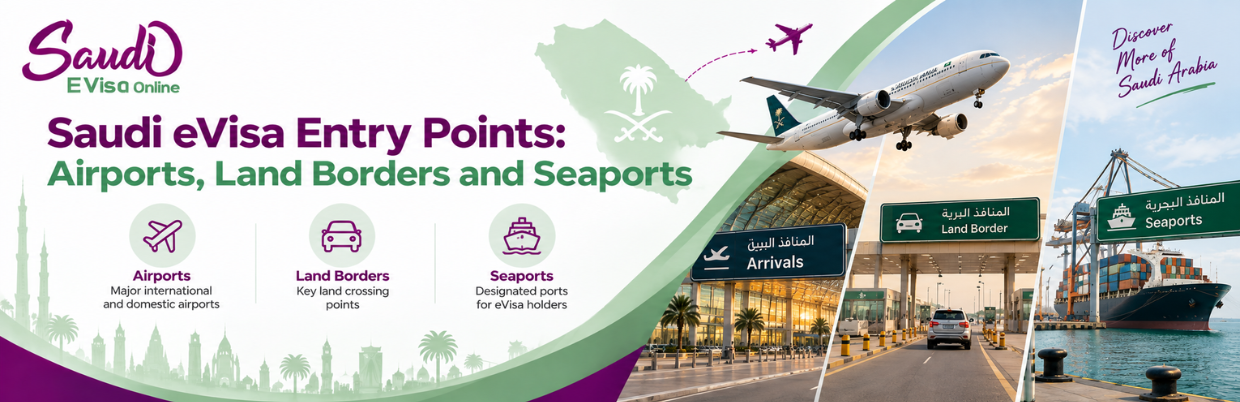
Saudi Arabia can be entered through air, land, and sea routes, but the exact entry points accepted depend on the visa type. For a Saudi eVisa, the official terms specifically confirm saudi evisa entry points through all airports and seaports. Your visa must also be valid and used with the same passport submitted in the application.
Planning ahead matters more for this visa than travellers sometimes expect. An approved eVisa is not a guarantee of entry on its own; it is permission to present yourself at the border and be assessed there. Knowing which entry points are covered, what paperwork typically accompanies each route, and where the rules get less clear-cut can save you from an awkward conversation at the counter. The sections below walk through air, land and sea options in turn, followed by a rundown of what to have ready when you reach immigration.
Airports
Air travel is the most common way to enter Saudi Arabia, and for most eVisa holders it is also the simplest. Major international airports include King Abdulaziz International Airport in Jeddah, King Khalid International Airport in Riyadh, King Fahd International Airport in Dammam, and Prince Mohammad bin Abdulaziz International Airport in Madinah. Each of these has dedicated eVisa or e-gate lanes at peak times, though queue lengths vary with flight schedules and the season.
Saudi eVisa holders can enter through Saudi airports, provided they meet the visa and immigration conditions on arrival. In practice this means presenting a passport with the required remaining validity, having your eVisa approval readily available (on your phone or as a printout), and being prepared to answer routine questions about the purpose and length of your stay. Airport arrivals also tend to move faster because airline check-in staff at your departure airport will often verify eVisa details before you board, which catches basic errors before you ever reach the Saudi border.
Smaller airports with international flights, such as those serving AlUla, Abha and Taif, follow the same rule, but routes change often, so confirm your arrival airport with your airline. Airlines periodically add or drop routes to these regional airports, and not every regional airport handles the same mix of international carriers year-round, so it is worth rechecking your itinerary closer to departure rather than assuming last year's routing still applies. During some past Hajj seasons, visit-visa holders were told to arrive through Riyadh instead of Jeddah, Madinah, Yanbu or Taif, so check seasonal restrictions if you travel around Hajj, since capacity management at the airports nearest the holy cities can change which gateway is open to which category of traveller. Our guide to the Umrah visa vs Hajj visa explains those dates and how they differ from a standard tourist eVisa.
Land Border Crossings by Country
Saudi Arabia has land borders with the UAE, Bahrain, Qatar, Kuwait, Oman, Jordan, Iraq, and Yemen. Travellers entering by land should confirm that their specific visa permits the intended land crossing before starting the journey. Land travel appeals to road-trippers, GCC residents visiting family, and anyone combining Saudi Arabia with a wider Gulf itinerary, but it also comes with more variables than flying: staffing levels at a given post, vehicle inspection requirements, and how busy the crossing is on a particular day of the week all affect how smoothly things go.
Do not assume that an eVisa automatically guarantees admission at every land border. The official eVisa terms specifically state that the eVisa is valid for entry through all airports and/or seaports, while entry remains subject to immigration approval. Travellers using the official eVisa terms as a reference should still confirm the crossing they plan to use with the Saudi authorities or their visa provider.
These are the main crossings, named from the Saudi side first:
| Country | Crossing (Saudi side / other side) | Notes |
|---|
| UAE | Al Batha / Al Ghuwaifat | The only UAE land crossing, open 24 hours, and the busiest for tourists |
| Bahrain | King Fahd Causeway (Al Khobar side) | A 25 km bridge-causeway with passport control midway, very busy on weekends |
| Qatar | Salwa / Abu Samra | The only land link with Qatar, and the route for drivers going between Qatar and the UAE |
| Kuwait | Al Khafji / Nuwaiseeb | Vehicles only, with no pedestrian crossing |
| Jordan | Haql / Durra | Connects Aqaba to the northwest coast and Tabuk |
| Jordan | Halat Ammar / Mudawara | Central crossing toward Tabuk |
| Jordan | Al Haditha / Al Umari | The largest land port, on the route toward Riyadh and Ha'il |
| Oman | Empty Quarter (Rub' Al Khali) crossing / Ibri | Opened in December 2021, a long desert route |
| Iraq | Arar | Mainly commercial, not usually used by tourists |
| Yemen | Al Tuwal, Al Wadeeah and Haradh | Not for tourist travel |
Crossing names and spellings vary between maps and sources, and a crossing can close or change its rules at short notice. The four crossings that matter most to tourists are Al Batha, the King Fahd Causeway, Al Khafji and the Jordan border posts. It's worth building slack into your schedule around any of these, particularly if you are trying to make a connecting flight or a hotel check-in on the other side, since processing times can stretch well beyond what a map's driving-time estimate suggests.
Driving Into Saudi Arabia
Overland entry needs more paperwork than flying. Bring your passport with at least six months of validity, a printed copy of your eVisa, the vehicle registration, your driving licence and mandatory Manafith third-party insurance for a non-Saudi-registered car. If the car is not in your name, carry a No Objection Certificate, and check that a rental company allows cross-border trips, since many refuse Saudi crossings. Expect longer queues than at an airport, especially on Thursday and Friday evenings, when weekend leisure traffic between neighbouring Gulf states peaks.
It also pays to think through the practical side of a road crossing before you arrive at the gate. Fuel up and check tyre pressure on the side you're leaving from, since prices and station availability can differ once you cross. Keep printed copies of every document rather than relying solely on your phone, in case of a dead battery or patchy signal at the post. If you are travelling with children, confirm whether either side asks for additional consent paperwork when a parent is travelling without the other. And because land posts can vary in how strictly they apply rules compared with airports, build in a buffer of an hour or two beyond what you'd normally allow, particularly on public holidays or around major regional events.
Residents of Gulf states should also read our guide to the Saudi eVisa for GCC residents, and travellers passing between Qatar and the UAE should see the Saudi transit visa 96 hours page.
Seaports
Saudi Arabia also accepts eligible travellers through its seaports. This can be relevant for visitors arriving by cruise or other permitted sea travel, and interest in this route has grown as more international cruise lines add Red Sea itineraries that call at Saudi ports.
For eVisa holders, the official terms confirm that the eVisa is valid for entry through all Saudi airports and seaports. Cruise itineraries and port procedures vary, so check with your cruise line whether passengers need to arrange visas themselves or whether the line handles group visa processing on your behalf. Some cruise operators build visa costs and paperwork into the ticket price and coordinate directly with port authorities, while others expect each passenger to arrive with an individually approved eVisa; find out which applies well before your sailing date so you're not sorting it out at the last minute.
What to Show at Immigration
Keep your travel documents easily accessible when you reach the border. You should generally have:
- The same passport used for the visa application
- A copy of your Saudi eVisa or visa approval
- Any required supporting travel documents
- Accommodation or onward-travel details if requested
Saudi eVisa holders must carry a copy of the eVisa on their first arrival, and biometric details are captured by immigration authorities on arrival. Importantly, having an approved eVisa does not guarantee entry; the final decision remains with the immigration officer. A calm, straightforward manner at the counter helps: answer questions clearly, have your documents organized rather than buried in a bag, and avoid volunteering information that wasn't asked for. If an officer asks for something you don't have to hand, it's usually faster to say so plainly and offer what you do have than to hold up the line searching.
Our checklist of Saudi eVisa requirements covers what to prepare. For eligibility, see the Saudi eVisa eligible countries list, and for airport arrivals without an eVisa, read our guide to the Saudi visa on arrival.


 Share







Pooja is a travel and visa content writer specializing in visa requirements, travel procedures, and immigration information for international destinations. She researches visa rules, documentation, application processes, entry requirements, and travel updates to create clear, practical guides that help travelers understand the visa process and plan their journeys with confidence.