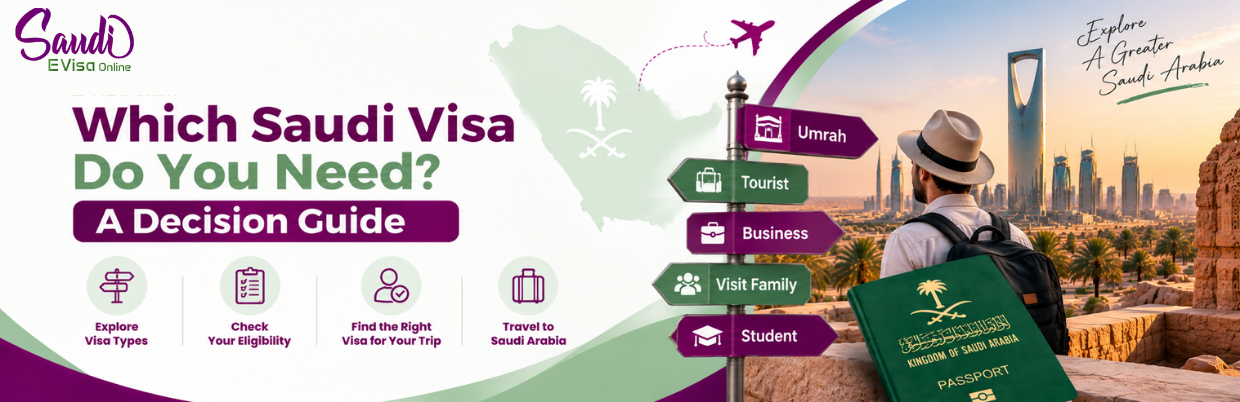
If you're unsure which Saudi visa fits your trip, the right route depends mainly on why you're travelling and which passport you hold. Tourist travel, business activities, Umrah, transit, and sponsored visits each come with different requirements, and a few visa categories sit outside what we process at all. This guide walks through each route so you can identify yours and apply with confidence.
Answer in 30 Seconds about "Which Saudi Visa do i Need"
| Your Purpose | Likely Route |
|---|
| Tourism | Tourist eVisa |
| Tourism, eligible nationality, last-minute | Visa on arrival |
| UK citizen | UK ETA or tourist eVisa |
| Family visit | Sponsored visit visa |
| Business meeting | Tourist eVisa may cover it |
| Formal business visit | Business visit visa |
| Umrah | Tourist eVisa or Umrah route |
| Short transit | Transit / stopover visa |
| Work | Not processed |
| Residence | Not processed |
| Hajj | Not processed |
| Study | Not processed |
Your nationality, country of residence, and travel purpose should all be checked before settling on a route — this table is a starting point, not a final answer.
Tourist eVisa
The Saudi tourist eVisa is designed for eligible travellers visiting for tourism, leisure, events, and permitted Umrah travel. Eligibility depends largely on nationality, though certain alternative routes may apply — qualifying GCC residency, for instance, or holding a valid, previously-used UK, US, or Schengen visa.
For eligible travellers, applying online before departure is generally the easier option, since the visa is arranged in advance rather than left to chance at the border. Once you know you're eligible, the application itself is straightforward: passport details, a compliant photo, and basic travel information, submitted through the online portal.
Visa on Arrival
Eligible travellers may be able to obtain a Saudi tourist visa when they arrive at an approved entry point, rather than applying in advance. The eligibility list broadly follows the tourist eVisa's nationality requirements, though specific conditions can apply depending on your circumstances. See Saudi Visa on Arrival for the fee, which airports offer it, and a full comparison against applying online.
Visa on arrival can be genuinely convenient for last-minute travel — if a trip comes together with only a few days' notice, it's often the only realistic option. But applying for the eVisa in advance still gives you more certainty overall, because your eligibility and documents are checked before you travel rather than at the immigration counter after a long flight. If anything is wrong — a passport nearing expiry, an eligibility issue, a document problem — you find out while you still have time to fix it, rather than at the border.
UK ETA
Eligible British citizens have a third option that most other nationalities don't: Saudi Arabia's Electronic Travel Authorization. The ETA is separate from the tourist eVisa and allows multiple visits during its validity period, which runs longer than the standard eVisa. See Saudi ETA for UK Citizens for who qualifies and how it compares to the tourist eVisa.
It's intended for permitted tourism-related travel and does not allow employment or Hajj. It's worth being explicit here: UK residents who don't hold an eligible British citizen passport shouldn't assume they qualify simply because they live in the UK, and dual nationals should be careful to apply and travel using the same passport tied to their ETA.
Sponsored Visit Visa
A sponsored visit visa becomes relevant when your Saudi trip is based on a family relationship or a business invitation rather than ordinary tourism. This is a meaningfully different process from the standard tourist eVisa, since it depends on someone in Saudi Arabia — a relative or a company — actively sponsoring your visit rather than you simply applying based on your own eligibility.
For family visits, the Saudi-based sponsor generally initiates the relevant process on their end before you can proceed with your own application. See Saudi Family Visit Visa for how the sponsor's invitation works, the required documents, and the fee. For business-related visits, the inviting company or organisation typically needs to provide the required sponsorship or invitation documentation, and because sponsorship requirements vary by the nature of the visit, it's worth confirming the specifics for your situation rather than assuming a single standard process covers every case.
Business Visit Visa vs. Business Activities on the eVisa
This is one of the areas travellers most often get wrong, because the tourist eVisa does cover certain business-related activities — attending meetings, conferences, or events — without requiring a separate business visa at all. Where people run into trouble is assuming this extends further than it actually does: the tourist eVisa should never be treated as a work authorization, and it doesn't cover formal commercial activities like negotiating contracts, signing agreements, or anything resembling paid work.
If your trip goes beyond simply attending a meeting or conference — formal business visits, commercial negotiations, or purposes that genuinely require sponsorship from a Saudi company — a dedicated business visit visa is the more appropriate route. See Saudi Business Visa vs eVisa for Meetings and Events for exactly which activities the tourist eVisa allows and when you need the dedicated route instead. Neither visa should be used as a substitute for the specific work authorization required for actual employment in the Kingdom.
Umrah
Eligible travellers can perform Umrah on a standard Saudi tourist eVisa, subject to the usual eligibility rules and the seasonal restrictions that apply around Hajj. This surprises some travellers who assume Umrah always requires its own dedicated visa — for many nationalities, it doesn't, and the standard tourist eVisa is genuinely sufficient.
That said, the visa itself is only part of the picture. Regardless of which route gets you into the country, you'll also need to complete the required Umrah authorization through the official Nusuk system before visiting Masjid al-Haram — this is a separate step from the visa, and skipping it is a common point of confusion even among travellers who did everything else correctly. See Umrah Visa Online for the full process, including the alternative route if your nationality doesn't qualify for the tourist eVisa.
It's also worth understanding that Umrah and Hajj are governed by entirely different rules. A tourist or Umrah visa cannot be used as a substitute for Hajj, and Saudi Arabia restricts access to Makkah during the Hajj season regardless of what visa you're holding. Anyone planning a trip that might overlap with Hajj dates should check current seasonal restrictions well before booking flights or accommodation.
Transit / Stopover
A Saudi transit or stopover option is designed for travellers passing through the country for a short period rather than taking a standard tourist trip. This is a genuinely different category from a tourist visa, and the right approach depends on your airline, your itinerary, your nationality, and how long you'll actually be on the ground.
If your layover is brief enough and you don't plan to leave the airport, you may not need any visa arrangement at all. But if you're planning to leave the airport during a longer layover — even for a few hours — it's worth confirming what's actually available and required for your specific routing before you book, rather than assuming a transit option will simply be available on arrival.
Visas We Do Not Process
To save you time, it's worth being upfront about what falls entirely outside what we handle. We do not process:
- Work visas — these require an employer sponsor and go through a separate government process tied to formal employment in Saudi Arabia.
- Residence visas — these are handled through Saudi immigration channels tied to long-term residency status, not tourism or short visits.
- Hajj visas — Hajj runs through dedicated official channels and licensed operators, entirely separate from tourist or Umrah routes.
- Student visas — these involve institutional sponsorship arranged through the enrolling academic institution directly.
These categories involve separate government procedures, sponsorship requirements, or institutional processes that sit outside the standard tourist and business visa framework. If your purpose falls into one of these categories, you'll need to go through the relevant official Saudi authority or sponsoring organisation rather than the process described in this guide.
How to Actually Decide
If you're still unsure after reading through the categories above, a useful way to narrow it down is to ask yourself a few simple questions in order. First: is this trip for leisure, visiting family, attending an event, or Umrah outside Hajj season? If so, the tourist eVisa is almost certainly your route, assuming your passport is eligible.
Second: does your trip involve any kind of formal business activity beyond just attending a meeting — negotiating, signing agreements, or representing a company in an official capacity? If so, lean toward the business visit visa rather than assuming the tourist eVisa will cover it.
Third: is someone in Saudi Arabia — a relative or an employer — actively sponsoring or inviting your visit, rather than you simply booking a trip on your own initiative? If so, you're likely looking at a sponsored visit visa rather than the standard tourist process.
Fourth: is your visit for work, long-term residence, Hajj, or study? If so, none of the routes in this guide apply to you, and you'll need to go through the dedicated official channel for that specific purpose.
Answering these in order will get most travellers to the right category quickly. Where it gets genuinely complicated is when a trip has mixed purposes — a family visit that also includes some business meetings, for example, or a business trip that's really more of an extended tourism stay — and in those cases, it's worth checking your specific situation directly rather than guessing based on the primary label of the trip.
A Note on Eligibility
Almost every route above assumes your nationality is actually eligible for whichever visa category applies. This is worth checking early rather than late — travellers sometimes work through this entire decision process, land on the right category, and only then discover their passport isn't on the relevant eligibility list. If that happens, it usually isn't a dead end: alternative routes like a qualifying US, UK, or Schengen visa, GCC residency, or a sponsored application often still apply, but they add a step to the process that's worth knowing about before you get too far into planning.
Final Thought
Choosing the right Saudi visa category up front saves far more time than it costs. An application submitted under the wrong category, or a tourist eVisa used for activities it was never meant to cover, tends to surface as a problem later — at the border, during processing, or in the middle of a trip — rather than being caught early when it's easy to fix. Taking a few minutes to confirm your category against your actual purpose, your passport, and your specific circumstances is a small step that avoids a much bigger headache down the line.


 Share







Pooja is a travel and visa content writer specializing in visa requirements, travel procedures, and immigration information for international destinations. She researches visa rules, documentation, application processes, entry requirements, and travel updates to create clear, practical guides that help travelers understand the visa process and plan their journeys with confidence.