



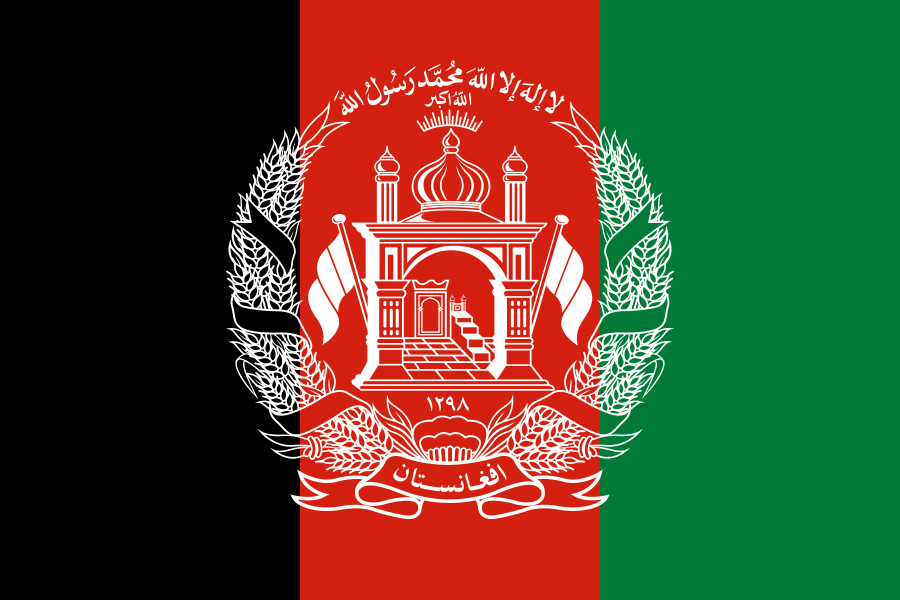
Saudi Visa for Afghan Citizens
About the Saudi Visa for Afghan Citizens
Afghanistan is not on Saudi Arabia's eVisa-eligible nationality list, which puts Afghan passport holders in a different position from travellers applying from most other countries. That doesn't mean a Saudi visa is out of reach — it means the route depends on your specific situation: which passport you hold, whether you carry a valid visa or residency for the US, UK, Schengen area or a GCC country, and whether you're travelling for Umrah, business or a family visit. This guide sets out exactly where Afghan citizens stand, and what to check before applying.
Saudi Visa Eligibility for Afghan Citizens
Afghan citizens are not eligible for the standard Saudi eVisa or visa on arrival under normal circumstances. Afghanistan does not appear on Saudi Arabia's list of roughly 60+ nationalities that can apply for the tourist eVisa purely on the strength of their passport. For most Afghan applicants, the default route is a regular visa filed through the Saudi Embassy in Kabul.
There is an important exception, and it's the same exception Saudi Arabia applies to every non-listed nationality, Afghanistan included: if you hold a valid, used visa for the UK, US, or a Schengen country (with an entry stamp from that country), or you hold valid permanent residence in the UK, US or EU, or you hold a qualifying GCC residence permit (typically requiring a minimum remaining validity, commonly cited at three months or more beyond your Saudi entry date), you can generally apply for the Saudi eVisa online rather than through the embassy.
Citizenship and residence are two different things here. Holding a Turkish, UAE or European residence permit doesn't change your nationality — it's your Afghan passport that Saudi immigration checks against the eligibility list, and your residence status that may or may not unlock the eVisa exception above. Confirm which category you fall into before choosing an application route.
Saudi Embassy and Consular Services for Afghan Citizens
Saudi Arabia maintains an embassy in Kabul, but its operating history over the past few years has been unusually disrupted, and it's worth understanding before you plan around it:
- Saudi diplomats were withdrawn from Kabul in August 2021 as the Taliban took control of the capital.
- Limited consular services resumed in November 2021, alongside humanitarian work through the King Salman Humanitarian Aid and Relief Center (KSrelief).
- In February 2023, Saudi staff were evacuated again following a security threat near the diplomatic quarter where the embassy is located.
- Full embassy activities resumed on 22 December 2024, and relations have continued to develop since — including Saudi mediation in a Pakistan–Afghanistan prisoner matter in early 2026, and a Saudi-Afghan energy exploration agreement signed in September 2026.
Saudi Arabia, like the vast majority of governments, does not formally recognise the Islamic Emirate of Afghanistan, but the embassy in Kabul continues to provide consular services to Afghan citizens on that basis. Given this history, confirm current opening hours, required appointments, and processing procedures directly with the embassy before travelling to submit an application — don't rely on older listings, including this one, without checking first.
Saudi Visa Options for Afghan Citizens
For Afghan applicants who qualify for the eVisa exception described above, the standard Saudi eVisa products apply:
| Saudi Visa | Entry | Price | Processing Time | Stay Validity | Visa Validity |
|---|---|---|---|---|---|
| 1 Year Multipurpose Saudi E-Visa | Multiple Entry | $300 | 3–4 Days | 90 Days | 1 Year |
| 90 Day Multiple Saudi E-Visa | Multiple Entry | $200 | 2–3 Days | 30 Days | 90 Days |
The 1-Year visa does not mean 365 continuous days in the Kingdom — it means the visa itself can be used across a 12-month window, with each individual visit capped at 90 days. The 90-Day visa works the same way over a shorter window, with each visit capped at 30 days.
If you don't hold a qualifying UK/US/Schengen visa or residency, these eVisa products aren't available to you directly — your route is the regular visa through the Saudi Embassy in Kabul, priced and processed according to visa category and embassy assessment rather than a fixed online fee. Regular visa processing can run considerably longer than the eVisa — commonly cited at up to several weeks depending on the category — so build in extra time.
Saudi Visa Fees for Afghan Citizens
Afghan citizens applying under the eVisa exception pay the standard $300 or $200 fee shown above, which covers the government e-visa charge, service processing, and the insurance bundled into the eVisa product. Afghan citizens applying through the regular visa route at the embassy should expect government and processing charges to be set by the embassy directly, and these can vary by visa category (tourist, family visit, business, Umrah) — we'd recommend confirming the exact figure with the embassy or with us before assuming a fixed total.
Documents Afghan Citizens Need for a Saudi Visa
Whichever route applies to you, expect to prepare:
- A passport valid for at least six months beyond your planned entry date. Afghanistan resumed issuing passports physically identical in format to the pre-2021 document, and passport services now operate through the interior ministry's passport department across the country's provinces, as well as through Afghan diplomatic missions abroad for renewals.
- A recent passport-style photograph.
- Completed application details matching your passport exactly.
- Confirmed travel details, and accommodation information where requested.
- A return or onward ticket.
- Travel insurance, where required for your visa category.
- For the eVisa exception route: proof of the qualifying UK/US/Schengen visa or residence permit, or GCC residency document, that establishes your eligibility.
A document issue specific to Afghan applicants: because Saudi Arabia does not recognise the current Afghan government, applications through the regular visa route commonly involve closer manual scrutiny of supporting documents than a routine eVisa application would — the passport itself is accepted as a valid travel document, but expect more back-and-forth on supporting paperwork than nationals of eVisa-eligible countries typically experience.
How Afghan Citizens Can Apply for a Saudi Visa
- Confirm which route applies to you — eVisa exception, or regular visa through the embassy.
- If eVisa-eligible: select the correct visa type on the application, prepare your documents including proof of the qualifying UK/US/Schengen visa or residency, and submit online.
- If applying through the embassy: contact the Saudi Embassy in Kabul directly to confirm the current application procedure, required documents for your specific visa category, and any appointment requirements.
- Enter your passport and personal details accurately — mismatches between application data and passport data are a common cause of delay for any nationality, and the added scrutiny on Afghan applications makes accuracy even more important.
- Pay the applicable fees — the fixed eVisa charge if that route applies to you, or the embassy's stated fee for a regular visa.
- Track your application and keep copies of everything submitted.
- Receive and verify your visa before finalising flight bookings.
Flying from Afghanistan to Saudi Arabia
Kabul International Airport (KBL) is Afghanistan's main international gateway and the hub for Ariana Afghan Airlines and Kam Air, both of which operate nonstop flights from Kabul to King Abdulaziz International Airport in Jeddah (JED), with a flight time of roughly 5 hours 45 minutes. Turkish Airlines, flydubai and Air Arabia also serve the route with a single connection, typically through Istanbul, Dubai or Sharjah.
Outside Kabul, Afghanistan's other airports with international service — Herat, Kandahar, and Mazar-i-Sharif — are primarily served through Ariana Afghan Airlines' network and generally route through Kabul or a regional hub for onward travel to Saudi Arabia, rather than offering direct Jeddah or Medina service themselves.
For Hajj specifically, Afghanistan's Ministry of Hajj and Religious Affairs organises dedicated charter flights each season, historically operated by Ariana Afghan Airlines, landing pilgrims directly into Medina or Jeddah depending on the year's arrangements. Hajj and Umrah travel for Afghan citizens is arranged through this dedicated channel and Saudi Arabia's Hajj/Umrah authorisation system rather than through the tourist eVisa — meaning it isn't affected by Afghanistan's absence from the eVisa eligibility list in the same way tourist travel is.
Top Saudi Destinations for Afghan Travellers
- Medina and Makkah — the primary destinations for the large share of Afghan travel to Saudi Arabia that is religious in purpose, covering Hajj and Umrah.
- Jeddah — the main arrival point for both pilgrims and business travellers, given its direct Ariana and Kam Air connection to Kabul.
- Riyadh — increasingly relevant for Afghan business travel following the expansion of Saudi-Afghan economic ties, including the 2026 energy exploration agreement between Saudi's Delta International Energy and Afghanistan's Ministry of Mines and Petroleum.
- Dammam — relevant to the small but growing energy and resources business connection between the two countries.
- AlUla — a newer leisure destination for Afghan travellers combining a Saudi trip with tourism beyond the holy cities.
Why Afghan Citizens Travel to Saudi Arabia
Religious travel dominates the Afghanistan–Saudi Arabia travel relationship: Umrah trips and the annual Hajj pilgrimage account for the largest and most consistent flow of Afghan travellers to the Kingdom, organised in large part through dedicated charter arrangements rather than individual tourist applications. Beyond religious travel, the relationship has a growing business dimension — Saudi Arabia has signed new energy exploration agreements with Afghanistan's mining and petroleum sector in 2026, and Saudi Arabia has also played a mediating role in regional disputes affecting Afghanistan, both of which point to more frequent official and business travel between the two countries going forward. Family visits also make up part of the picture, given the Afghan diaspora present in Saudi Arabia, which is served on the Saudi side by Afghanistan's own consulate general in Jeddah.
Common Saudi Visa Issues for Afghan Applicants
- Assuming eVisa eligibility — the most common and costly mistake is applying (or attempting to apply) for the standard eVisa without holding a qualifying UK/US/Schengen visa or residency, when Afghanistan isn't on the base eligibility list.
- Passport validity — falling under the six-month rule is a routine rejection reason across all nationalities and applies equally here.
- Incomplete supporting documentation for the regular visa route, where manual review tends to be more thorough than a standard eVisa check.
- Relying on outdated embassy information — given how often the Kabul embassy's operating status has changed since 2021, information more than a few months old should be reconfirmed before you travel to apply in person.
- Wrong visa category for the actual purpose of travel — Hajj/Umrah, business, and family-visit routes are handled differently, and mixing them up causes delays.
A Detail Most Generic Saudi Visa Pages Miss
Because Saudi Arabia's Hajj and Umrah system runs on its own authorisation channel — separate from the tourist eVisa — Afghan citizens are not shut out of religious travel to Saudi Arabia by their absence from the eVisa eligibility list. The eVisa restriction is specific to tourist-route travel; Hajj and Umrah access for Afghan pilgrims continues to run through Afghanistan's Ministry of Hajj and Religious Affairs and Saudi Arabia's own Hajj/Umrah quota and authorisation system, independent of the eVisa nationality list. This is a distinction worth knowing before assuming that eVisa ineligibility rules out a religious trip.
Ready to Check Your Saudi Visa Eligibility?
If you hold a qualifying UK, US, Schengen or GCC visa or residency, check your eligibility and apply for the Saudi eVisa that matches your travel plans. If you don't, we can help you understand what the embassy route involves before you start. Approval is never guaranteed and always rests with Saudi authorities.
Apply Online
Saudi Visa Packages for Afghan Citizens

90 Days Umrah Visa
Single Entry


Important note :

- Your passport photo must be clear — do not cover your face with paper, fingers or any other object.
- The photo must have a plain white background.
- Enter your name and passport number exactly as printed in the passport.
Must have :
- A passport valid for at least six months from your travel date.
- A recent colour photo and a clear scan of the passport details page.
- A hotel booking and return ticket are not needed to apply. Immigration may ask for onward travel details on arrival.

FAQ