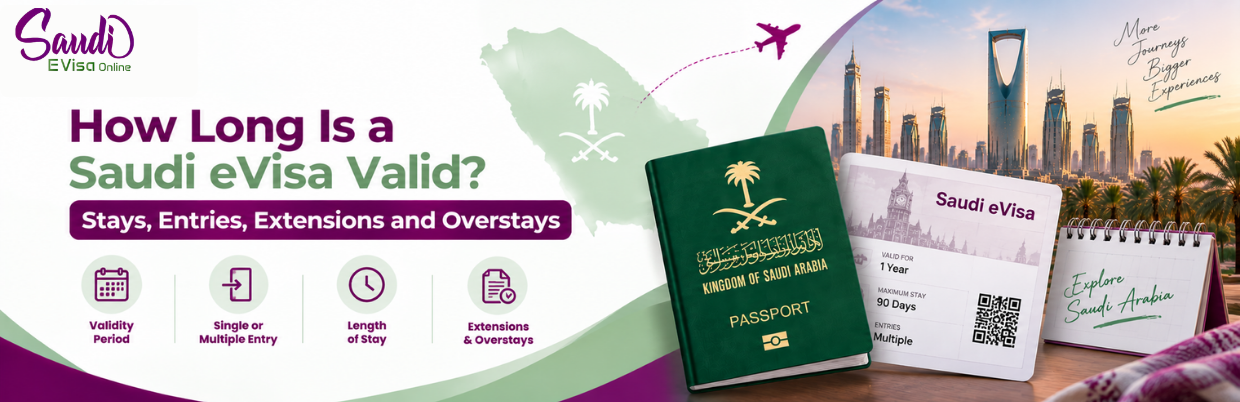
Saudi visa validity and permitted length of stay are two different things, and mixing them up is one of the most common — and most costly — misunderstandings travellers run into. A visa can remain valid for use over a long period while any single visit is limited to a much shorter stay. Get this distinction wrong and you risk an overstay fine, an unexpected block on future visas, or a scramble to leave the country before a deadline you didn't realise applied to you.
Quick summary before we go deeper:
| Term | What it actually means |
|---|
| Visa validity | The window during which you can use the visa to enter Saudi Arabia |
| Length of stay | How long you can remain after each individual entry — a separate, shorter limit |
| Multiple entry | Lets you leave and re-enter within the validity window — this is not unlimited stay |
| Extension | Not available on the tourist eVisa, under any circumstance, through any platform |
| Overstay | Can trigger fines, exit complications, and affect future visa eligibility |
This guide walks through exactly how Saudi visa validity works, what "multiple entry" actually allows, whether an eVisa can be extended, and what happens if you stay too long.
Validity vs. Length of Stay: Two Separate Clocks
It helps to think of every Saudi tourist visa as running two separate countdowns at once, rather than one.
- Visa validity is the period during which the visa itself can be used to enter Saudi Arabia. If your visa is valid for one year, that means you can use it to enter the country any time within that twelve-month period — not that you're entitled to stay in the country for a year.
- Length of stay is a completely separate limit: how long you're permitted to remain in Saudi Arabia after each individual entry. This resets with every fresh entry, up to whatever cap applies to your specific visa, but it's bounded independently of how much time is left on the visa's overall validity.
A visa might remain valid for a full year, while each individual stay is capped at a much shorter period set by that specific visa type. The visa's overall validity expiring does not reset or extend any individual stay, and remaining beyond your permitted period can result in penalties, regardless of how much validity remains on the visa itself.
The single most important thing to understand here: your visa validity tells you when you can travel. Your permitted stay tells you how long you can remain once you're there. They are not the same number, and a longer validity period does not automatically buy you a longer stay.
Per-Visit Stay Limits Depend on Which Visa You Hold
This is where travellers most often get tripped up: the permitted stay per visit is not the same across Saudi Arabia's tourist visa options, so the number that applies to you depends entirely on which visa you actually hold — not on some universal Saudi visa rule.
| Visa Type | Stay Per Visit | Visa Validity |
|---|
| 1-Year Multipurpose Visa | Up to 90 days | 1 year |
| 90-Day Multiple Entry Visa | Up to 30 days | 90 days |
Notice that in both cases, the visa's validity period is considerably longer than any single stay. A valid visa in your passport does not mean you're free to remain in Saudi Arabia continuously for the entire validity window — it means you can make trips within that window, each one bounded by the shorter stay limit attached to your specific visa.
This distinction matters most for travellers planning an extended visit, a series of business trips, or a long Umrah season stay. Someone holding the 90-day visa who assumes they get 90-day stays — because that number appears elsewhere in Saudi visa content, often attached to the other visa type — can find themselves accidentally overstaying by weeks.
Always check your own visa's specific terms before travelling. Don't assume either figure applies to you by default — confirm the exact stay allowance, validity period, and fee for your visa type before you apply or fly.
Does a Long Validity Mean Long-Term Residence?
A related misunderstanding worth addressing directly: does holding a visa valid for a full year mean you can effectively live in Saudi Arabia for that year, provided you occasionally cross a border and come back? The answer is no, and this is worth being explicit about because it's a genuinely common assumption.
A few things worth knowing:
- Saudi tourist visas are designed around a pattern of visits, not continuous residency.
- Even where a visa permits multiple entries across its full validity period, your entries and cumulative time in the country are still expected to remain within the spirit of a tourist visa — not a substitute for a residency permit.
- Treating a multiple-entry tourist visa as a way to establish long-term residence — hopping across a border every 90 or 30 days purely to reset a stay clock — is not what these visas are designed for.
- Immigration authorities can and do scrutinise travel patterns that look like an attempt to use a tourist visa as a residency workaround.
If your actual goal is longer-term residence in Saudi Arabia, a tourist eVisa is the wrong instrument entirely, and you should be looking at the appropriate residency or work visa route instead.
Multiple Entries: How Re-Entry Actually Works
A multiple-entry visa allows you to leave Saudi Arabia and return while the visa remains valid, provided you still meet the applicable entry conditions at the time of each re-entry.
In practice, this means you could:
- Enter Saudi Arabia
- Leave once your permitted stay for that visit is up (or earlier, by choice)
- Travel elsewhere — a neighbouring Gulf state, home, or onward to a different destination
- Return later using the same still-valid visa, without needing to reapply
This is genuinely useful for someone combining a Saudi Arabia trip with visits to neighbouring countries, someone making repeated business trips over the course of a year, or someone performing Umrah more than once within the visa's validity window.
What multiple entry does not mean:
- Unlimited stay
- An automatic reset each time you cross a calendar period
- Guaranteed re-entry — Saudi immigration authorities retain discretion at the border, and factors like your remaining passport validity, prior travel history, and whether your documentation is in order can all affect whether re-entry is granted smoothly
If your travel plans genuinely require leaving and re-entering Saudi Arabia multiple times, confirm before you travel that your specific visa is the multiple-entry type — this isn't guaranteed by default, and a single-entry visa works very differently.
Can a Saudi Tourist eVisa Be Extended?
This is one of the most frequently asked questions about Saudi visa validity, and the honest answer is straightforward: no, not in the way many travellers hope.
Tourist visa holders should not assume that a Saudi tourist eVisa can simply be extended through Absher or Muqeem, the government platforms many people associate with Saudi immigration services generally. The official Saudi eVisa terms state that the tourist eVisa itself cannot be extended once issued.
Why the confusion happens: Absher and Muqeem are genuinely used for a wide range of Saudi immigration and residency services — renewing an iqama, managing exit and re-entry permits for residents, handling various visa transactions tied to residency status. Having heard that these platforms can extend "visas" in some general sense, travellers sometimes assume the same applies to their tourist eVisa specifically. It doesn't. Access to Absher or Muqeem for other purposes does not mean every visa type, including the tourist eVisa, can be extended through them.
If your permitted stay is coming to an end:
- Leave Saudi Arabia before you become an overstayer.
- If you're still eligible and your visa remains valid, re-enter later using the same multiple-entry visa.
- Or apply for a fresh, appropriate visa if your circumstances have changed.
What you should not do is treat your existing eVisa's expiry or your stay limit as something that can be quietly extended after the fact. Waiting until close to your deadline in the hope that an extension option will appear is a common and avoidable way to end up overstaying inadvertently.
Overstay Fines and Immigration Consequences
Remaining in Saudi Arabia after your permitted stay has expired — whether that's the per-visit stay limit or, in the case of a single-entry visa, the visa's own validity — can result in overstay penalties and broader immigration consequences.
Depending on how the overstay is handled and how long it lasts, this can:
- Affect your ability to leave the country without first resolving your status
- Affect your eligibility for future Saudi visas, potentially well beyond the immediate trip
This is a genuinely serious matter. An overstay is not simply a matter of paying a small fee on the way out — depending on the circumstances, resolving one can involve visits to immigration offices, delays to your departure, and in some cases restrictions on returning to Saudi Arabia in the future. None of this is worth risking to squeeze a few extra days out of a trip.
The practical takeaway: don't wait until the last day if there's any uncertainty about your visa's expiry date or your permitted stay. If you're unsure how many days you have left, or which limit applies to your specific visa, check your visa documentation directly rather than estimating based on something you read elsewhere. Building in a buffer of a few days before your actual deadline — rather than planning your departure for the exact final permitted day — costs you nothing and protects you from the kind of last-minute complication that can turn a planned departure into an accidental overstay.
Single-Entry 30-Day Visas: A Different Set of Rules Entirely
Not every Saudi tourist visa is multiple entry, and it's worth understanding how a single-entry visa differs, since the rules around re-entry and validity work quite differently.
A single-entry 30-day visa allows exactly one entry into Saudi Arabia and a stay of up to the period stated on the issued visa — typically 30 days, as the name suggests.
The critical difference from a multiple-entry visa: once you leave Saudi Arabia on a single-entry visa, it cannot normally be used for another entry, even if time technically remains on the visa's stated validity period. The visa is genuinely single-use for the purpose of entering the country — leaving effectively closes it out, regardless of how much of its validity window is theoretically unused.
If there's any chance you'll want or need to leave Saudi Arabia and return during the course of your trip — a short hop to a neighbouring country, an unplanned return home partway through your visit, or simply wanting the flexibility — a single-entry visa is the wrong choice. Check whether you qualify for one of the multiple-entry options instead before applying. Reapplying for a fresh visa after an unplanned single-entry exit is far more disruptive than simply holding the right visa type from the outset.
Choosing the Right Visa for Your Travel Pattern
| Your situation | Best fit |
|---|
| One contained trip, no need to leave and re-enter | Single-entry visa |
| One trip, or two trips close together this year | 90-Day Multiple Entry Visa (30-day stay per visit) |
| Repeated travel over the next 12 months — business, family, or Umrah | 1-Year Multipurpose Visa (90-day stay per visit) |
Because the exact fees, processing times, and precise terms attached to each visa type can be checked directly on the relevant product page, it's worth confirming the current details there before applying rather than relying solely on a general guide like this one.
For the exact validity period, stay length, and current fee for your situation, see the 1-Year Multipurpose Visa or 90-Day Multiple Entry Visa pages directly.


 Share








Pooja is a travel and visa content writer specializing in visa requirements, travel procedures, and immigration information for international destinations. She researches visa rules, documentation, application processes, entry requirements, and travel updates to create clear, practical guides that help travelers understand the visa process and plan their journeys with confidence.