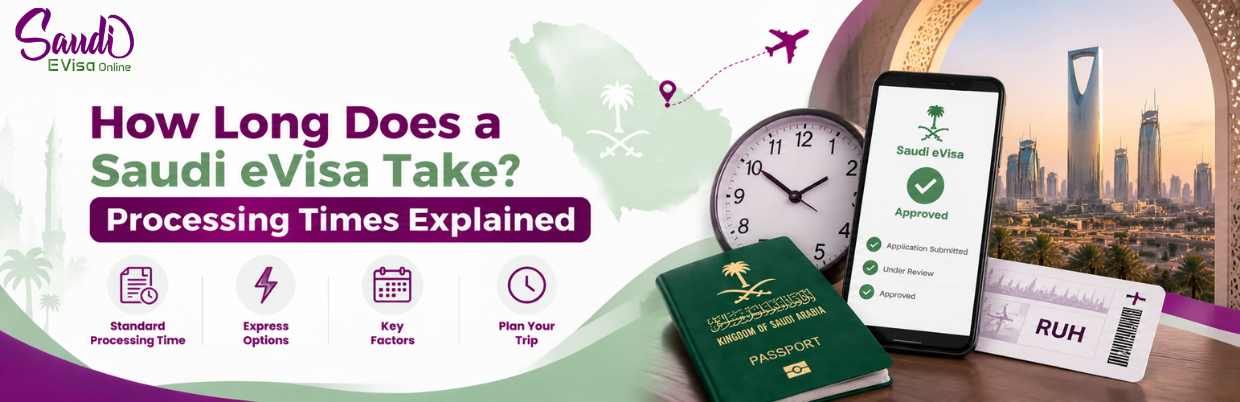
If you're preparing to travel to Saudi Arabia, one of the first practical questions is simple: how long will it take to get the eVisa back? The honest answer is that it depends — on the visa type, on how clean your application is, and on whether anything about your case needs a closer look. This guide walks through realistic Saudi evisa processing time, what causes delays, how weekends and public holidays affect the count, and what your options are if your travel dates are close.
For checking the live status of an application you've already submitted, head to our Saudi Visa Status page — that's where you'll find the actual lookup tool and a breakdown of what each status label means. This article focuses on timing: what to expect and why.
How Long Does the Saudi eVisa Actually Take?
There's no single number that applies to every applicant, because Saudi Arabia's eVisa system processes each application on its own merits rather than issuing approvals in a fixed batch cycle. That said, most travellers can work with the following general expectations:
| Route | Typical Timeline |
|---|
| Official government processing | Ranges from a few minutes up to 3 business days |
| Our standard service | 24–72 hours |
| Our express service | Priority handling, where available |
The official Saudi tourism visa guidance states that service duration can range from as little as one minute to three business days. In practice, a large share of applications are approved well within that window — often within a matter of hours — but a portion of applications take the full window, and a smaller number take longer still if additional checks are triggered. Because of this spread, it's best to treat any stated timeline as a realistic estimate rather than a guarantee, and to build in a buffer before your departure date rather than applying at the last possible moment.
Why Processing Time Varies So Much
It helps to understand what's actually happening behind the scenes once you submit an application. The Saudi immigration system runs each application through a series of automated and manual checks: verifying passport data, cross-referencing biometric and photo requirements, and running standard security and eligibility screening. For the majority of applicants — those with a valid passport, a compliant photo, and no red flags in their travel or immigration history — these checks complete quickly and the visa is issued with no back-and-forth.
Where timelines stretch out, it's almost always because one of these automated checks has flagged something that needs a closer, manual look. That doesn't necessarily mean there's a problem with the application; it simply means a human reviewer needs to confirm something the system couldn't resolve on its own. Below are the most common reasons this happens.
Visa Type and Purpose of Travel
Tourist and multi-purpose eVisas tend to move through the system fastest, since they're the highest-volume, most standardised category. Business-related applications, or those linked to a sponsor or invitation letter, sometimes take a little longer because the reviewing officer may need to verify the sponsoring company's details or the nature of the visit. Umrah-adjacent applications submitted through the tourist eVisa route are generally processed on the same timeline as standard tourism, though volume can spike around religious holidays and Ramadan, which can add to overall processing time industry-wide during those periods.
Data Accuracy
This is, by a wide margin, the most common reason an application takes longer than expected. If your name, date of birth, or passport number is entered even slightly differently from how it appears on your passport, the system may not be able to automatically match your record, triggering a manual review. Double-checking every field against your passport before submitting is the single most effective thing you can do to avoid unnecessary delay.
Photo Quality
Saudi authorities have specific requirements for the passport-style photo submitted with an eVisa application — a plain background, no shadows, a neutral expression, and no head coverings unless worn for religious reasons. A photo that doesn't meet these standards can be rejected outright or flagged for manual review, both of which add time to the process. Using a plain white or light grey background and taking the photo in even, natural light avoids most of these issues.
First-Time Applicants and Travel History
Applicants who have never previously travelled to Saudi Arabia, or who have a limited international travel history on their passport, are sometimes subject to slightly more thorough review than repeat visitors. This isn't a penalty — it's simply that the system has less prior data to draw on. It's a normal part of the process and doesn't indicate anything has gone wrong with the application.
Additional Security or Eligibility Checks
In a smaller number of cases, an application may be flagged for an additional review based on criteria the Saudi authorities don't publish in detail. This can include checks tied to nationality, occupation listed on the form, or previous visa or immigration history in the region. These checks are entirely at the discretion of Saudi immigration and cannot be expedited or bypassed by any visa service, including ours.
Incomplete or Inconsistent Information
Applications with blank fields, inconsistent dates (such as a departure date that doesn't logically follow an arrival date), or details that contradict information elsewhere in the form are more likely to be paused for clarification. Reviewing the full form carefully before submission — rather than rushing through it — reduces this risk significantly.
What "Under Process" and "Pending" Actually Mean
Two status terms come up often enough that they're worth explaining briefly here, even though the full status-checking tool lives on our dedicated status page.
Under process means your application has been received and is actively being reviewed. It is not a rejection, and it doesn't mean anything has gone wrong — it simply means the decision hasn't been finalised yet.
Pending similarly indicates that a final decision hasn't been reached, or that some part of the review is still in progress. If your status shows as pending and hasn't changed in a day or two, the right move is to wait rather than submit a second, duplicate application — submitting again does not speed up the original review and can occasionally create confusion between two records tied to the same traveller.
For a full explanation of every status label you might see, along with the tool to check your own application, visit the Saudi Visa Status page.
Weekends and Saudi Public Holidays
One detail that catches travellers off guard is that Saudi visa processing times are generally measured in business or working days — not straight calendar days. This matters more than it might seem. If you submit an application on a Wednesday and the stated processing window is "up to 3 business days," that window may not conclude until the following Monday or Tuesday once a weekend is factored in.
Saudi public holidays — including Eid al-Fitr, Eid al-Adha, and Saudi National Day — can add further time, both because government offices operate on reduced schedules and because application volume tends to spike in the days leading up to and following major holidays as travellers plan trips around them. If you're submitting close to a weekend or a known public holiday, it's worth mentally adding a day or two of buffer rather than assuming your visa will land exactly within the stated window.
Processing Time by Visa Duration Option
Saudi Arabia's tourist eVisa is available in two duration options, and it's worth knowing that choosing between them does not meaningfully change how quickly your application is processed — both go through the same review pipeline. Where they differ is purely in how long the resulting visa is valid for and how long you can stay per visit:
- 90-Day Multiple Entry Visa — typically processed within 2–3 days through our standard service, valid for 90 days from issue, allowing stays of up to 30 days per visit.
- 1-Year Multipurpose Visa — typically processed within 3–4 days through our standard service, valid for a full year, allowing stays of up to 90 days per visit.
If your primary concern is speed rather than long-term validity, neither option holds a meaningful advantage — the choice should be based on how often you plan to travel to Saudi Arabia over the coming year, not on which one clears review faster.
Can You Get a Saudi eVisa Faster?
If your departure date is approaching and you're concerned about timing, there are a few things worth knowing.
Express or priority processing, where available, can help move an application through the queue faster, and this is genuinely useful when time is tight. However, it's worth being direct about what expedited processing can and can't do: no legitimate visa service — including ours — can guarantee approval within a fixed number of hours, because the final decision and timing rest entirely with Saudi immigration authorities. What expedited handling does is prioritise your application within the review queue; it does not, and cannot, skip or shortcut the underlying security and eligibility checks.
The most reliable way to get a fast decision, regardless of which service tier you choose, is to submit a clean application the first time: accurate passport details entered exactly as they appear in your document, a photo that meets the stated requirements, and complete, consistent information throughout the form. An error that has to be corrected after submission will almost always cost more time than any expedited processing option saves. If your travel date is only a few days away, it's worth having your documents double-checked before submitting rather than relying on express processing alone to make up for an incomplete application.
What to Do If Your Application Is Taking Longer Than Expected
If you've submitted your application and the standard processing window has passed without a decision, the first and best step is to check your current status through the official tracking tool rather than guessing or assuming the worst. You can do that on our Saudi Visa Status page, using the reference details you received at submission.
A few things worth keeping in mind while you wait:
- A longer-than-average wait does not automatically mean your application has been refused. Many applications that take slightly longer than the typical window are still approved.
- Avoid submitting a second, duplicate application in the hope of a faster result. This can create confusion between two records under your name and, in some cases, slow things down further rather than speeding them up.
- Keep your reference number and the email address used at application accessible, since you'll need both to check your status or to contact support if you do need help.
- If your status hasn't updated after several days beyond the stated processing window, reaching out to support with your reference details is a reasonable next step.
Planning Around Processing Time
The most practical takeaway from all of the above is timing your application sensibly rather than treating the shortest stated processing window as something to cut close to. A few general guidelines:
- Apply at least one to two weeks before your intended travel date wherever possible, even though most approvals arrive far sooner. This gives you a buffer if your application happens to fall into the smaller group that takes the full processing window or slightly longer.
- If you're applying close to a weekend or a Saudi public holiday, add extra buffer days to account for reduced processing capacity during those periods.
- Double-check every detail on your application against your passport before submitting — this one habit prevents the majority of avoidable delays.
- If your trip is genuinely last-minute, ask about express processing, but go in with realistic expectations about what it can and can't guarantee.
Final Thoughts
Most Saudi eVisa applications move through the system quickly — often within hours rather than days — and the vast majority of travellers never experience a delay worth worrying about. The cases that do take longer are almost always explained by one of the factors above: a data mismatch, a non-compliant photo, or an additional check that simply needs a little more time. Submitting a careful, accurate application is the best safeguard against delay, regardless of which visa duration or service tier you choose.
If you've already applied and want to check where things stand, the Saudi Visa Status page has the tools you need. If you haven't yet applied and have questions about eligibility, documents, or fees, our FAQs page covers the most common questions, or you can start your application directly on our apply page.


 Share






Pooja is a travel and visa content writer specializing in visa requirements, travel procedures, and immigration information for international destinations. She researches visa rules, documentation, application processes, entry requirements, and travel updates to create clear, practical guides that help travelers understand the visa process and plan their journeys with confidence.